Intelligent Design:
"The March of Progress" and its Descent in Editorial Cartoons

(Written in July, 2007. Some of the cartoonists interviewed no longer work for the papers identified, and some have since, sadly, passed away.)
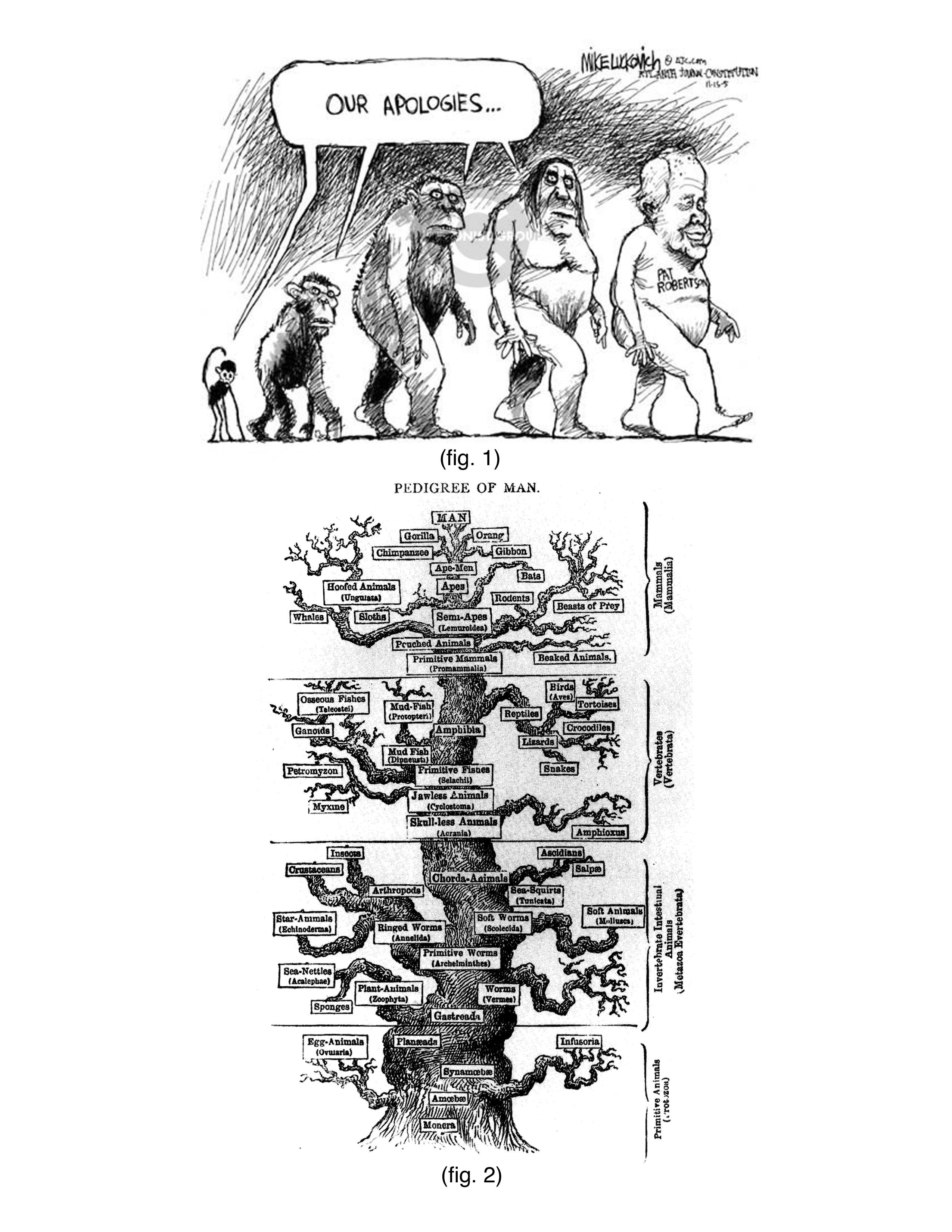
A parade of figures marches across the frame of an editorial cartoon drawn by the Atlanta Constitution’s Mike Luckovich, where human evolution is depicted in the familiar image of a linear progression from monkey to man. Instead of ending with a nameless figure representing upright, modern man, the image culminates in the naked figure of Pat Robertson proudly strutting along, oblivious to the sad chorus of his antecedents, who apologize for leading to the eventual development of Mr. Robertson. (fig. 1)
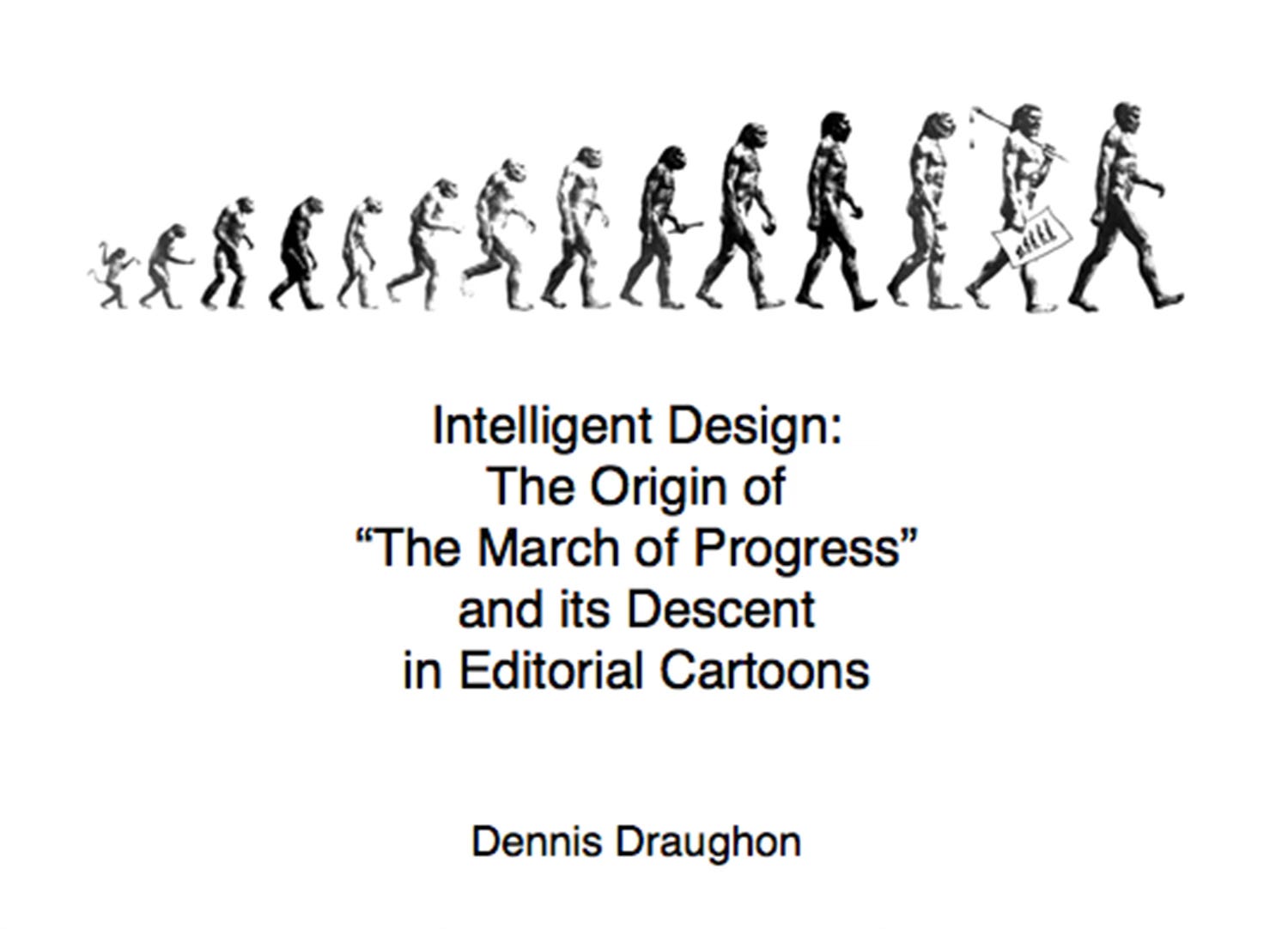
This cartoon is just one example of the many ways modern editorial cartoonists continue to employ one of the most widely recognized and dispersed icons associated with evolutionary biology. The development of this popular image, widely referred to as the so-called “March of Progress,” can be traced through a long historical lineage in the scientific illustration of evolutionary concepts, although the image most used by editorial cartoonists today is of a relatively recent vintage, first appearing over one hundred years after the publication of Darwin’s Origin of Species. Since its debut, the March image has been frequently copied, imitated, parodied and widely distributed, appearing not only in editorial cartoons, but in a myriad of comic strips, advertisements, science textbooks, popular magazines, museum displays, web sites and television sitcoms. The popularity of the March icon is undoubtedly linked to its immediate and persuasive message that evolution is a process of progression and that modern man is the end result. This message runs contrary to one of the main tenets of Darwin’s evolutionary theory: that descent with modification is the random result of natural selection and not the result of some progressive force that propels living things toward some future goal. In spite of the March icon’s misleading and inaccurate portrayal of human evolution, its ubiquity demonstrates its success as a scientific illustration integral to the propagation and popular acceptance of the Darwinian paradigm. Whether they accept Darwin’s theories or not, when American editorial cartoonists reproduce a version of the March to visually express their opinions, they are contributing to the icon’s continued dispersal and reinforcing the popular perception of its fallacious depiction of human development, while still lending overall credence to a generalized conception of evolution.
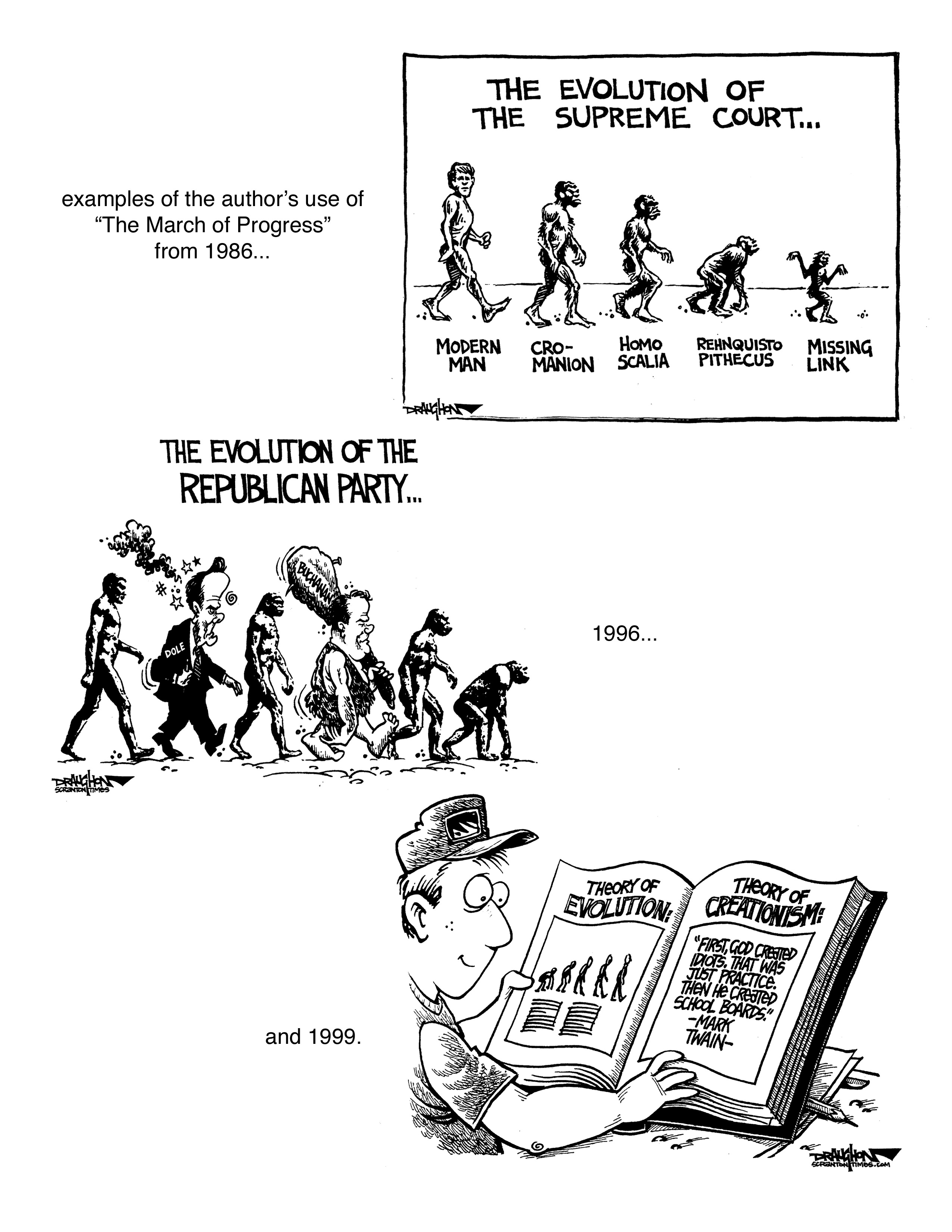
The March image referenced in today’s editorial cartoons first appeared in 1965 in the popular Time-Life book Early Man, edited by the paleoanthropologist F. Clark Howell. The image includes fifteen figures representing the path to Homo sapiens, from the Miocene ape Pliopithecus to fully modern humans. Rudolph Zallinger, an illustrator best known for his panoramic murals of dinosaurs and early mammals done for Yale University’s Peabody Museum, completed the commissioned illustration with the help of Elwyn Simons, then the head of the museum’s Division of Vertebrate Paleontology, who suggested the succession of drawings of reconstructed human ancestors. Simons saw the sequence of pictures as a shorthand view of a process of change in form, but he did not think the sequence represented progression to a “perfect” human form, even though this seems to be the most predominant interpretation of the icon. Neither Zallinger or Simons imagined that the image they collaborated on would become the most repeated of logos related to paleoanthropology. Since its appearance in the Time-Life series, Zallinger’s image, or some version of his image, has been reprinted world wide in many biology texts and has appeared countless times in popular press accounts of human evolution, not to mention the scores of variations, parodies and lampoons of the icon dispersed through other media.
Many of the cartoonists working today became familiar with the icon just as the author did, either through school biology classes or numerous newspaper and magazine stories. Gary Varvel, cartoonist for the Indianapolis Star, says the icon is one that “everyone who has come through the public school system has been thoroughly indoctrinated to understand.” The March is a simple visual argument that appeals to both the veteran and the budding cartoonist alike. One of the features that makes the icon so compelling is the inherent cinematic nature of the image. As it moves from left to right, frame by frame, it allows the mind’s eye to fill in the intervening spaces and makes it easy to imagine the characters animatedly morphing as the image moves forward. The narrative form of the icon encourages us to consider humankind as the hero of its implied “rags to riches” story. Another aspect of the icon that makes it a potently persuasive scientific illustration is its combination of rhetorical and demonstrative cues. Rhetorically, the icon supports a definite conclusion by directing the viewer’s concepts in the same manner as an informed, verbal argument. Demonstratively, the icon supports a conclusion by appealing to the viewer’s visual literacy. Put together, the March demonstratively suggests a set of changes in the physical stature of hominids that it rhetorically explains as progress in quality. Each stage of the image is a significant transition point on the long road from animal to modern human, from a natural state to a cultured one. Each transition suggests a pattern for future ones, a pattern easily extrapolated into our future. Matt Weurker, cartoonist for Politico.com, calls the icon “the best and most universal image for the concept of progress,” while Clay Bennett, of The Christian Science Monitor, says the image not only represents human evolution but can also broadly represent “progression, modernization, advancement or change.”
The fact that so many cartoonists were exposed to the March image through their school biology instruction emphasizes the importance placed on visual representations in the teaching and circulation of scientific themes in education. Scientists use diagrams and visual images not only to communicate their ideas but also to form them. Stephen Jay Gould points out that “primates are visual animals, and the key to concepts and their history often lies in iconography. Scientific illustrations are not frills or summaries: they are the foci for modes of thought.” The graphics used by scientists help them to visualize a “working hypothesis,” and the visual lexicon they develop works as a kind of shorthand to describe ideas and assumptions that their colleagues might find more understandable than would the uninitiated lay person. The same is true for cartoonists. Cartoonists can use certain visual conventions that other cartoonists readily recognize for their symbolic value, but these same tricks of the trade might not be as easily grasped by the reader. When scientists and cartoonists craft a visual argument there is always the concern that pictures that may contain specialized professional vocabularies or concepts may be misunderstood by the reader. That is an inherent risk in any visual communication where an icon stands for more than it shows. But a well-crafted icon can still be a highly persuasive image that can both convey information and convince people more effectively than words.
When Darwin published his On the Origin of Species in 1859, there was only one illustration in the book, a branching diagram that represented Darwin’s concept of his “principle of divergence.” Darwin used this one diagram to illustrate his expectation that descent with modification would lead to a branching array of ancestors and their descendants and the creation of collateral lineages of varying degrees of relatedness. Instead of the standard genealogical family tree that he would have been familiar with, Darwin turned the visual image upside down, and placed more emphasis on the branches in order to illustrate that increases in biological diversity took place without a single direction. In the late eighteenth and early nineteenth centuries, one new convention of scientific illustration was the increasing use of family trees and their branching patterns to visualize relationships in the natural world. There is also some evidence to suggest that the mid-eighteenth century appearance of linguistic phylogenies that traced the common descent of spoken languages in a similarly visual fashion might have influenced Darwin’s choice of diagram. This new type of visual conception began to replace the older scientific ideas that considered natural relationships arranged in a linear, hierarchical “Great Chain of Being.”
The visual abstraction of Darwin’s branching diagram was enthusiastically taken up by Ernst Haeckel, one of Darwin’s most ardent German supporters, who then fashioned the so-called “Tree of Life” images that were widely published in the 1870’s. The widespread dissemination of Haeckel’s well rendered tree diagrams, such as his “Pedigree of Man,” (fig. 2) continued to popularize an essentially linear and hierarchical concept of evolution. The notion of a chain of being was still evident in Haeckel’s drawings as his tree image still positioned humankind at the pinnacle of the main trunk, well above the stunted limbs representing the evolution of the “lower” orders of animals. The idea of progress was implicit in Haeckel’s trees, expressed in the ladder like arrangement of their branches. Haeckel’s tree diagrams essentially illustrated facets of his own personal belief in self-driven progress through natural processes. Haeckel saw evolution proceeding through the accumulation of Lamarkian acquired characteristics selected for fitness in a Darwinian fashion.
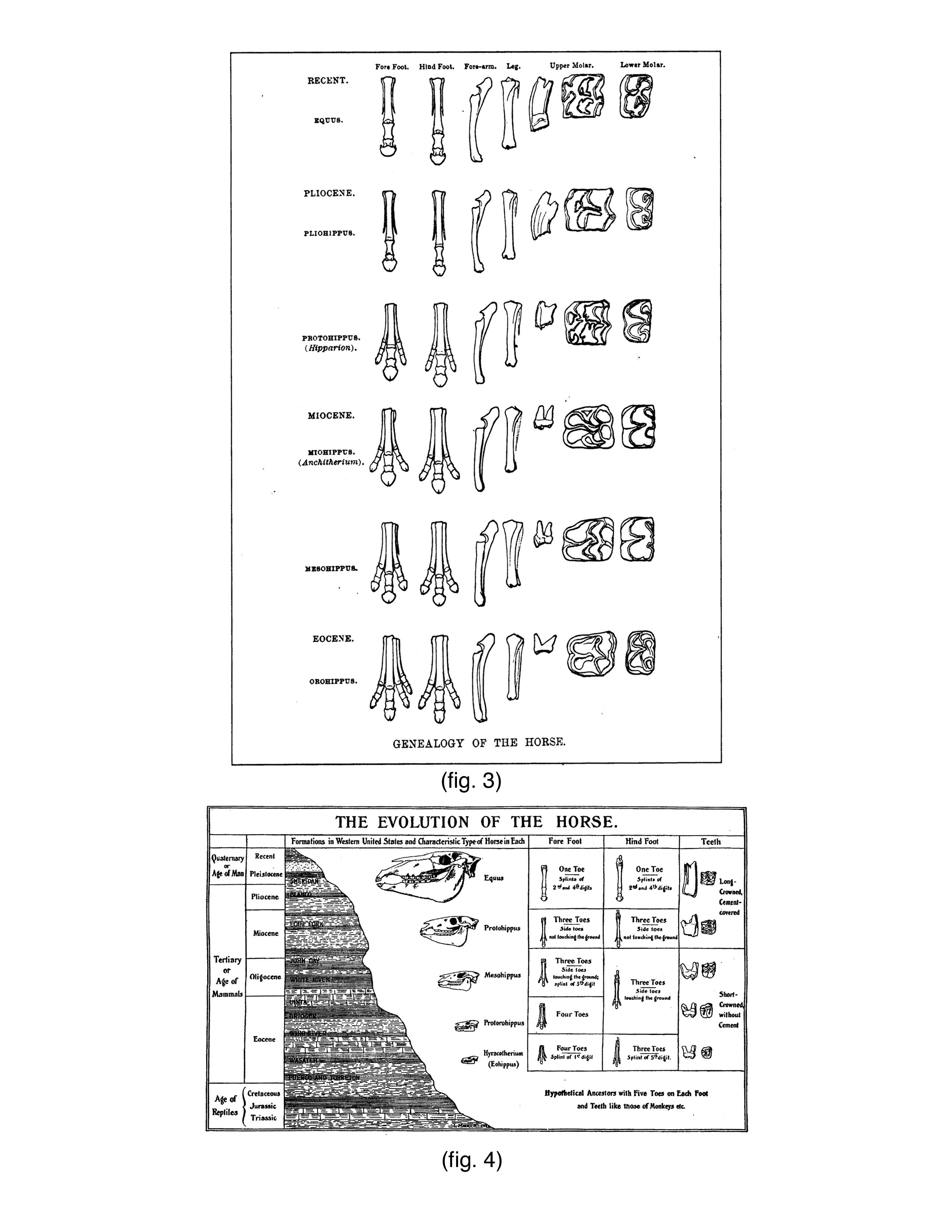
Another early scientific image used to illustrate the prejudiced idea of evolution leading to some kind of clear progression up a ladder of increasing perfection grew out of O.C. Marsh’s fossil horse collection at Yale College. In 1876, T.H. Huxley, also known as “Darwin’s Bulldog,” visited America to deliver an address in Baltimore after first stopping at Yale to see Marsh’s fossil horses. Huxley viewed the pedigree Marsh had constructed from the intermediate fossilized forms of the North American horse as proof of a direct line of descent that clearly illustrated Darwinian evolution. Huxley then asked Marsh to provide a chart of his fossil evidence in pictorial form so that Huxley could add a new dimension to the lectures he was giving to American audiences on evolution. (fig. 3) The result was one of the most widely reprinted and recognized visual depictions of evolutionary change, showing the ladder like ascension of uninterrupted progress that led upward from the bones of tiny Eohippus to the structure of modern day Equus. In 1902, W.D. Matthew would refine the Marsh diagram for use in a pamphlet by the American Museum of Natural History, by adding geologic strata to the sequence and associating them with the changes in horse anatomy over time, even though this pattern was a gross simplification that ignored complexity and side branches. (fig. 4)
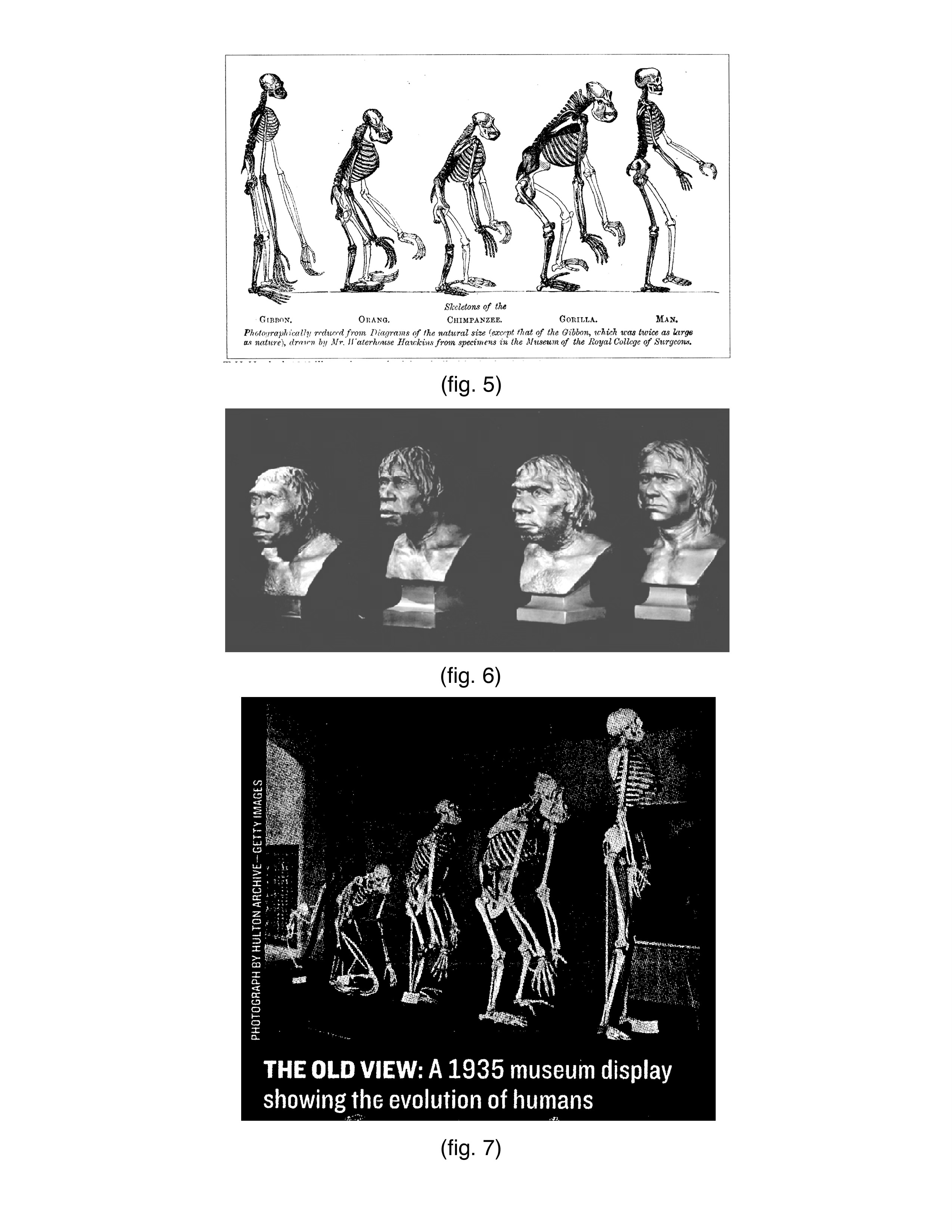
Huxley was also responsible for another image that could be seen as the direct progenitor of the March icon’s cavalcade. In 1863 he wrote a popular book titled Evidence as to Man’s Place in Nature , the frontispiece of which showed the similarities in skeletal structure between humans and other primates. (fig. 5) In his book Huxley claimed that there was a clear continuity expressed in the comparative anatomies of gibbons, orangutans, chimpanzees, gorillas and man. The accompanying engraving supplied compelling visual reinforcement for his argument by showing the skeletons of the four species of ape lined up, facing to the right in an evolutionary sequence very similar to the future Zallinger image. This first portrayal of human evolution as a kind of pageant from the long armed knuckle dragging of the apes to the upright posture of humans would spawn the depiction that would eventually become as iconic as the double helix of DNA.
Pictorial phylogenies continued to focus on common descent and the widespread reprinting of this genealogical concept held constant throughout the post-Origin century, helping to form the iconic image of biological evolutionism in the public mind. These visual pedigrees had the same impact as Huxley’s frontispiece in Man’s Place in Nature. Both kinds of image showed at a glance what experts thought to be the historical pattern of biological change.
All of the visual offshoots diverging from the lone illustration in Darwin’s Origin, demonstrate a deterministic, progressive, teleological pattern of evolution that infers a linear ascent from a “lower” order of beings to a “higher” form of animals, with the added assumption that the evolutionary process is concluded with the development of humans.
Popular scientific considerations of evolution have often been illustrated with pictures of extended linear parades showing the progression from “fish to man,” or even “amoeba to man.” Haeckel also illustrated his popular version of this linear model of the ascent of life, starting with some form of cellular life leading all the way up to man. But these various visual forms of directed ladders have distorted the actual scientific understanding of the evolutionary process. Evolution follows a chaotic, jagged procession of random events rather than one smooth gradual path, and evolution’s multiple pathways do not always lead to more complexity, nor do they necessarily lead to the development of modern humans. Rather than being the ultimate product of evolution, modern humans are just one outcome of an infinite number of plausible and actual possibilities. Ladders are thus false metaphors for Stephen Jay Gould, who insists that
“Bushes represent the proper topology of evolution... By imposing the model
of the ladder upon the reality of bushes, we have guaranteed that our classic
examples of evolutionary progress can only apply to unsuccessful lineages
on the very brink of extermination--for we can linearize a bush only if it maintains
but one surviving twig that we can falsely place at the summit of a ladder.”
New findings and new research in the fields of paleoanthropology and paleoneurology are slowly eroding the tendency to see the march of species down through time as a single-file parade, with descendant succeeding ancestor in a neat line of “begats.” New evidence shows that “progress” and “human evolution“ were only occasional partners. More than once in human prehistory, evolution created a modern trait only to let it go extinct, before trying again a few million years later. The human species’ travels through time proceeded in fits and starts, with long periods when nothing much happened, interspersed with intermittent bursts of rapid change. Since similar traits evolved more than once, they cannot be used as evidence that one fossil hominid is descended from another or that having an advanced trait means that a fossil hominid was a direct ancestor of modern humans. We now know that some branches of the human family tree represented in Zallinger’s “March of Progress” turned out to be evolutionary dead-ends and some of the figures depicted as evolving one after the other apparently coexisted for a long period of time. New fossil evidence recently discovered in Kenya suggests that Homo habilis and Homo erectus lived together as separate species inhabiting their own ecological niches, thus avoiding direct competition, for at least half a million years. The new evidence clearly contradicts the older idea of human evolution as a linear succession of species and supports the revised interpretations of “bushiness” and experimentation in the fossil record.
Today’s paleontologists favor a model of “allopatric” speciation, or the process of rapid, repeated episodes of species change on the peripheries of the main trunk line. In this “bushy” model, parental stocks coincide with the numerous, newer offshoots. New fossil finds seem to show many different varieties of hominids coexisting together on the African savanna between five and two million years ago. With these newest fossil findings in mind, the newest illustrative interpretations offered by the American Museum of Natural History use a more “bushy” family tree to depict the relations between modern humans and their direct and indirect ancestors, showing that during many periods, multiple hominid forms shared the African savanna. Some modern museum displays of human evolution now combine aspects of the “Tree of Life” and the “March of Progress” in a more complex axonometric presentation. This allows the viewer to see the March in three dimensions and makes it clear that ancestral hominids may have followed each other in time, but they did not necessarily emerge from or follow the same branching paths.
Darwin’s ideas about divergence in natural selection had little influence on early depictions of human evolution. In fact, Herbert Spencer’s more conventional concept of evolution as a purposive, progressive process was much more influential. By the early twentieth century Spencer’s philosophy continued to be the dominant influence on museum displays of human evolution, which popularized the progressive and linear presentation of human development. In the twenties and thirties the American Museum of Natural History’s Hall of the Age of Man widely promoted a linear sequence of busts and skeletons that can easily be seen as leading to the organic development of the March of Progress image. (fig. 6 & 7)
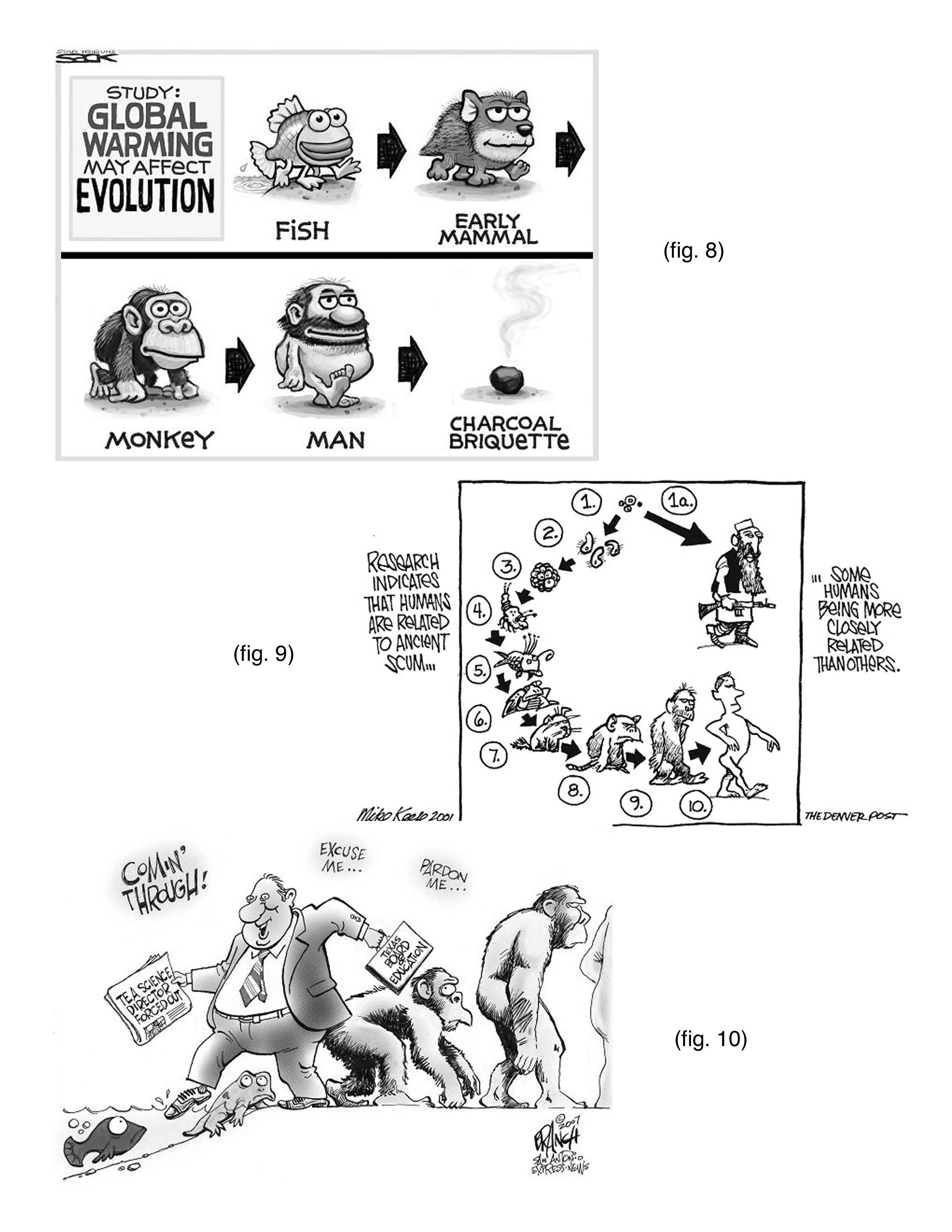
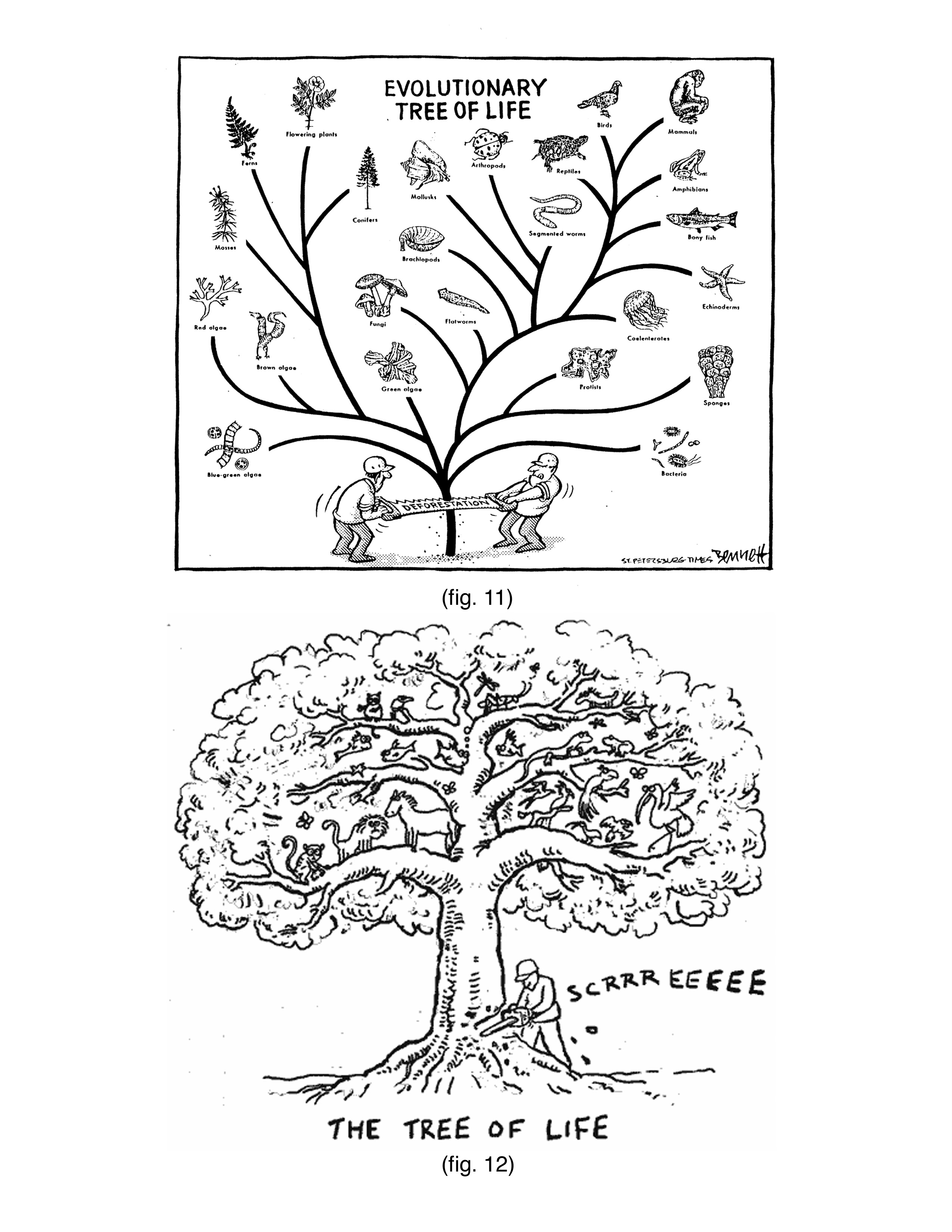
When Darwin’s Origin of Species was first published, the popular press reacted in part by portraying Darwin and his theory in cartoons. There were lots of apes and monkeys in the cartoons mocking Darwin’s implication about the common heritage between humans and the other primates. Darwin even appeared as an ape in some of the cartoons. By the 1870’s, the evolutionary tree made its first appearance in cartoons, with Darwin often drawn as a monkey sitting in, or swinging from the branches of a trunk labeled the “Tree of Life.” The combined images of an ape and a tree in cartoons became quickly identified and readily recognizable in public prints as icons for Darwin’s evolutionary theory of human descent. In contrast, modern cartoons about evolution feature a predominant use of the more linear “amoeba to man”(fig. 8, 9 &10) or “March of Progress” images. Contemporary cartoons rarely, if ever, reference a tree in depictions of evolution. An exhaustive search by the author turned up only two examples (one by Clay Bennett) and they both used the same visual gag of cutting down the “Tree of Life.”(fig. 11 & 12) A keyword search of “evolution” using the cartoon archive of the Association of American Editorial Cartoonists’ web site found no use of any “Tree of Life” images from 1997 through 2007, although there were plenty of cartoons using the March image, particularly in 2005. A similar search using the archives of The New Yorker’s cartoonbank.com and the web sites cartoonstock.com, cartoonistgroup.com and cagle.com failed to turn up any use of an evolutionary tree, but yielded a plethora of March parodies. Repeated Boolean image searches using Google for “Tree of Life” cartoons were also unsuccessful.
Even before the first appearance of “caveman” fossils and the discovery of Neanderthal remains in 1856, illustrators have struggled to depict prehistoric versions of humanity and the results have almost always been both highly speculative and restricted by accumulated visual traditions. The earliest reconstructive paleolithic images subtly demonstrated Victorian cultural and racial prejudices toward less civilized “savages” as well as European notions about progress. These early images were very popular, but they often said more about the milieu of the illustrator than the human ancestors which were being portrayed. The traditions, prejudices and speculations of those earlier prehistoric tableaux carried over into cartoons and caricatures about Darwin’s theory.
By the late nineteenth and early twentieth centuries, with the first visual reconstruction of a Neanderthal in 1873, the discovery of Java Man in 1891, and interest in the Piltdown hoax and more Cro-Magnon cave art finds early in the twentieth century, cartoons about cavemen and “missing links” became more popular with the public. By the time of the Scopes trial in 1925, most people were familiar with the new iconography of cavemen and missing links in visual depictions of Darwinism. Cartoons about monkeys, apes, ape men and cavemen became regular fodder for newspaper audiences from this decade on. No matter how many scientists objected to specious claims that humans were direct descendants of extant monkeys and apes, their demurrals were drowned out by the cacophony of cartoons, metaphors and parodies of monkeys and apes that dominated the popular debate by capturing the public’s imagination. The overwhelming impressions transmitted through these cartoons became impossible to dislodge. The public understanding of Darwinism was in large part created by the theory’s dissemination in pop culture vehicles like cartoons. Cartoons helped to make the idea of evolution less esoteric by provoking popular discussion with humor, thus making evolutionary theory more palatable and penetrable. Cartoons and caricatures were not just illustrations of the social ambivalence brought about by Darwin’s new materialistic theory. Instead they were an essential element to the formation of public opinions about evolution.
Around the same time as the Scopes trial, tree diagrams used to illustrate Darwin’s idea of increasing diversity were falling out of favor and being replaced by the more linear trees like Haeckel’s. In the 1920’s, Haeckel’s “Pedigree of Man,” Marsh and Matthew’s horse diagrams and Huxley’s lineup of primate skeletons were all frequently reproduced, reinforcing the popular teleological perception of directed human evolution. The powerful combination of images presented to the public in cartoons and misleading evolutionary diagrams was not easily dispelled by the words of more sober scientists. By the time of the 1965 publication of Time-Life’s Early Man book, the public was primed to accept Rudolph Zallinger’s “March of Progress” as the gospel.
Considered as a scientific illustration, the March icon is a grossly inaccurate form of shorthand but it is still useful and integral to the propagation of the Darwinian paradigm. It has largely replaced earlier versions of more directed trees in the public’s imagination and it appears to be more successful than the more scientifically accurate “bushy” illustrations of the diversifying effects of natural selection. The March is what Jonathan Wells refers to as the “ultimate icon” associated with evolution. Stephen Jay Gould echoed this sentiment, saying that “the March is the canonical representation of evolution-- the one picture immediately grasped and viscerally understood by all.” It is easy to see why this image is popular with cartoonists as they rely on the same sort of immediate reaction to effectively communicate with their audience.
Cartoons using the March icon, whether in forward or reverse, evolution or devolution, progression or regression, provide a useful template for a visual cliché where the final figure supplies the punch line. The sight gag diverts attention from the underlying assumptions of the sequence, including the very notion that it is a sequence that marks progress from left to right. Through repetition the cliché becomes a kind of common knowledge. The common knowledge in this case being the linear, goal-directed version of human evolution directly from apes. Thus the cartoons become a function of making evolution seem commonplace and matter-of-fact.
The abundance of modern editorial cartoons referencing some version of the March of Progress certainly suggests that the idea of evolution is common enough in the current profession of editorial cartooning to warrant some examination. Interviews conducted by the author with eleven other American editorial cartoonists found plenty of common ground in consideration of the March icon. All eleven cartoonists, in addition to the author, had used the image at some time in their careers, some more often than others. A wide variety of clever applications of the icon have been generated by these cartoonists, but the two most prominent have used the icon in either its original sequence or the reverse, with a wide range of meanings depending on the cartoon’s context. Several of the cartoonists, including Rex Babin of the Sacramento Bee and Clay Bennett of The Christian Science Monitor, said they used the image in its original sequence to show “progression, then retrogression.” (fig. 13 & 14)
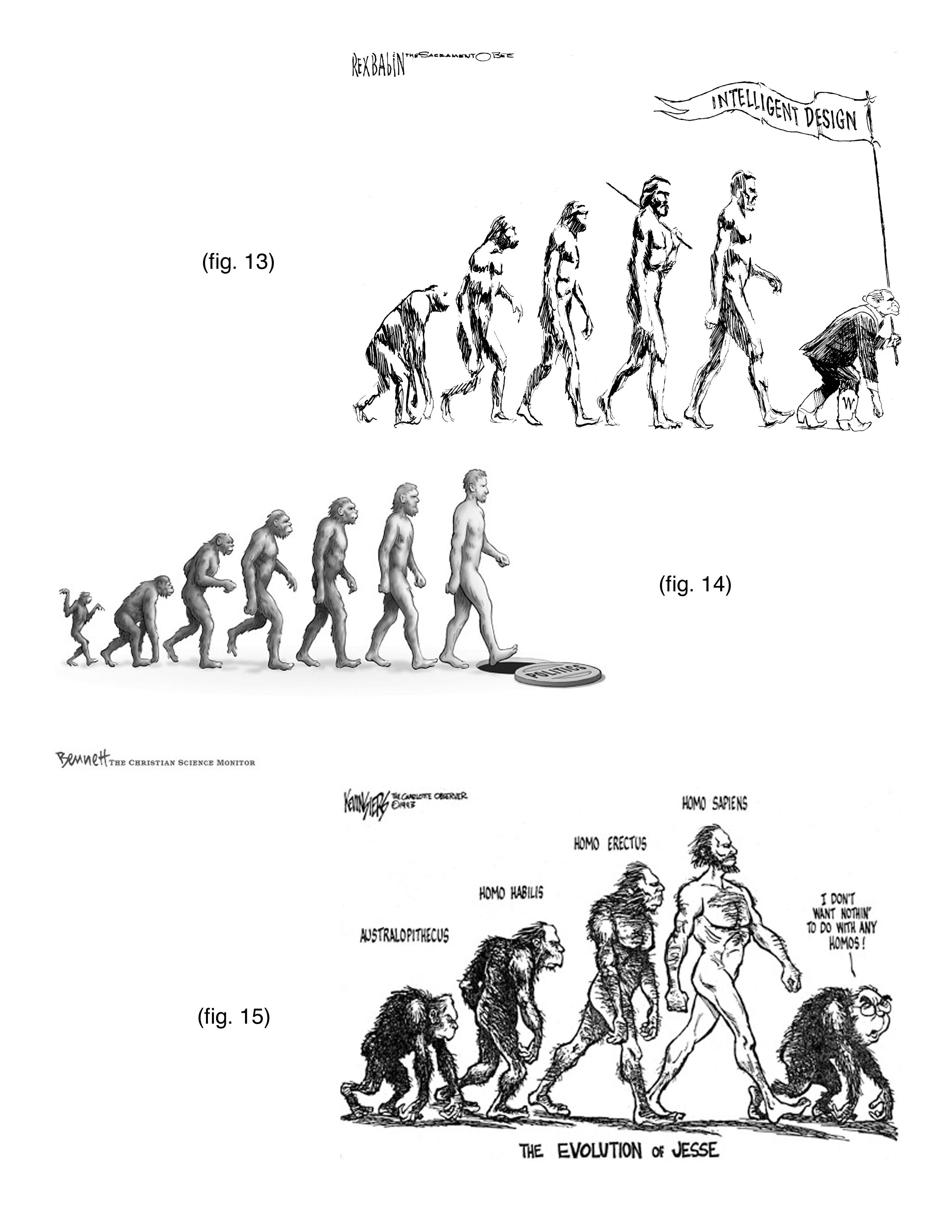
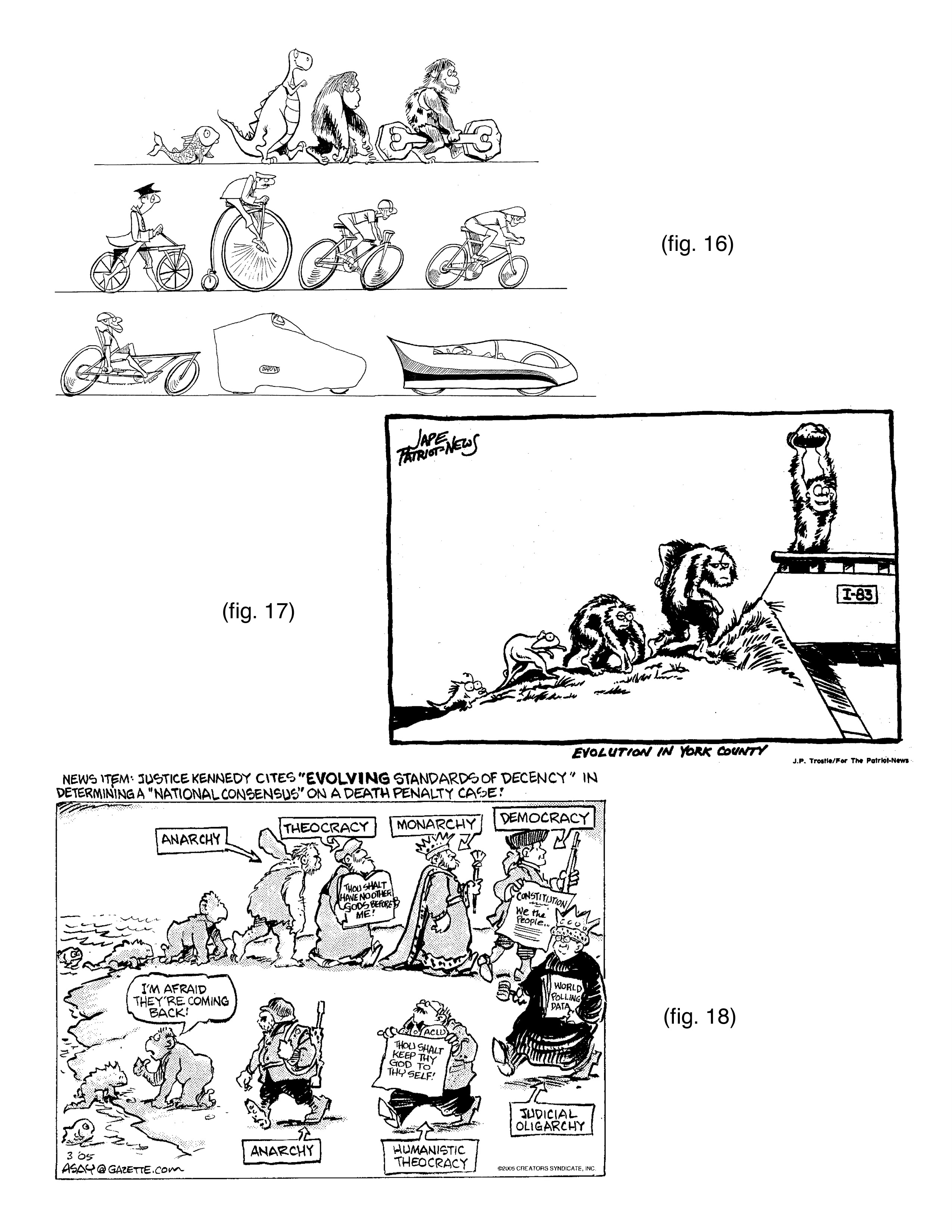
The cartoonists interviewed were evenly split on what they said the image meant to them, with half saying that the icon simply represented the concept of progress and the other half saying the icon was just a simplified representation of human evolution. Kevin Siers of the Charlotte Observer gave a nod to both notions, saying the March was “an icon representing progression, a simplified way to think about human origins.” (fig. 15) Gary Varvel said the image meant “one thing evolving into another which is more advanced and more complex than the one before it.” (fig. 16) Steve Benson of the Arizona Republic thinks the March “symbolizes either the advancement or retrogression in humankind’s historical thinking and attitudes.” Jape Trostle, formerly of the Chapel Hill Herald, considers the icon a catch all “that lends itself to so many things beyond progress and evolution-- time, movement, age, life...you name it. It is a wellspring of inspiration.” (fig. 17)
When asked if they believed in evolution, most of the cartoonists interviewed responded with an unequivocal “yes.” Two of the cartoonists who responded in the negative, Chuck Asay, formerly of the Rocky Mountain Gazette, and Gary Varvel, answered the question with respect to their religious sensibilities. Asay allowed for “examples of micro-evolution, like farmers and ranchers breeding animals to adapt to particular environments,” yet he did not think that there was proof “that species naturally advance from simple to complex.” (fig. 18) Steve Benson, who, interestingly enough, was once an ardent Mormon and whose grandfather, Ezra Taft Benson, was once president of the Church of Jesus Christ of Latter-day Saints, had an epiphany regarding evolution while taking science courses at Brigham Young University. He objected to the question of belief in evolution, thinking it inappropriate “for application in the scientific context of methodological experimentation and falsification.” Steve preferred to say that he accepted, based on observable, tested and predicted physical evidence “that organic evolution is an incontestable fact of nature that convincingly explains the origin... of life on Earth over eons of time.” Matt Wuerker added some levity to his affirmative answer, saying he believed in evolution “except when we’re de-evolving like the past eight years or so.”
When asked if the March of Progress reflected their personal understanding of human evolution or if the icon accurately reflected current scientific theory on human evolution, cartoonists’ responses were all over the map, spread evenly among yes and no answers for both questions. Jape Trostle likened the icon to “the famous dinosaur paintings in Life magazine that burned a particular image of ‘the dinosaur’ into our collective memory.” He said that regardless of subsequent scientific discoveries, “it is the first thing we think of when we hear the word dinosaur--so does the March of Progress pop up when evolution is discussed.” Kevin Siers realized the image is oversimplified, saying it “implies steady progression from a common origin, instead of the many false starts and dead ends evolution probably entailed.” Steve Benson accepted the image “in terms of visual shorthand only,” while Dwane Powell of the Raleigh News and Observer submitted that the image is “more metaphorical than scientific.” Clay Bennett responded that the March “may not reflect the exact lineage of human evolution, but it certainly does represent the science that proves such a lineage exists,” and Nick Anderson of the Houston Chronicle answered “yes” to both questions even though he thinks “it’s unfair to cavemen in Geico commercials.”
The majority of the cartoonists did not think that their audience needed a rudimentary understanding of or belief in evolution in order to understand cartoons that employed the March image. Most agreed with Jape Trostle, who thought that the image was “understood in a glance by most everyone. Even those who don’t believe in evolution get its meaning.” Clay Bennett concurred with that sentiment, saying that “this image is so universal in its concept, and so direct in its symbolism, that it transcends either a knowledge of, or a belief in evolutionary science.” Four of the cartoonists went further, saying that the image had become a readily accepted visual idiom that bordered on becoming a cliché. Chuck Asay was the lone religious dissenter who thought that while “most people are aware of the Darwinian image and understand the implications that mankind could have less advanced relatives, I also think that most people have a view that Darwin and the naturalists might be wrong.”
In a related question, the cartoonists were asked if they thought the image had become divorced from its original meaning through its frequent use out of context. The group responded with a unanimous “no.” Clay Bennett thought the image was malleable enough in application to be able to address many different themes and issues without confusion and yet still be “deeply rooted in the science that led to its initial rendering.” Jape Trostle agreed that the March icon had a remarkable resiliency and long shelf-life, saying that cartoonists can “use it a hundred different ways, and push their use of the image to the very edge of recognition, and the core concept remains intact.” But he also thought that the image was on the verge of overuse and dangerously close to becoming the sole provenance of the “lazy cartoonist.”
The cartoonists were evenly split on whether they used the March because of its specific association with the idea of evolutionary progress or used it just for the sake of convenience. Clay Bennett usually uses the image to convey both forward and backward movement simultaneously, as a depiction of progression without advancement. He said, “sometimes I’ve used the image as a visual representation of the theory itself (when commenting on creationist vs. Darwinism), while other times, it was used because of what the theory teaches (all life coming from primordial goo, for instance).” Kevin Siers used the image because “it conveyed a specific meaning, a way to illustrate Helm’s homophobia.” (see fig. 15) Matt Wuerker and Steve Benson both have used the image for its convenient accessibility. Wuerker said, “good cartoons dumb things down to reach a wide audience in a quick and facile way. This metaphor is so great because it does just that.” Benson echoed that assessment, saying the March “is a handy image for employment by artists desiring to convey an idea quickly and effectively to a mass audience.” Dwane Powell and Chuck Asay pointed out other advantages in their use of the March. Powell said that cartoonists rely on these types of images to make a point because “it helps to use an image that is in the public consciousness. Other examples are fairy tales, Mother Goose, ads that have great visibility, movies, etc.” Asay compared the ease of using Darwinism to illustrate progress or regression in cartoons to cartoons using the boy who cried wolf to epitomize overwrought exaggerations. Cartoonists definitely appreciate the versatility of the March icon.
Half of the cartoonists interviewed said their use of the March icon had generated significant negative response from readers due to the controversy over evolutionary concepts. Even those cartoonists who had not received angry letters and phone calls agreed with the majority that, regardless of reader reaction, the March image still had the power to influence the cartoonists’ audiences in some fashion. Nick Anderson thought the March was still influential, especially “if it’s used in an original and unexpected way.” Kevin Siers was somewhat ambivalent in his response, saying, “I don’t believe it influences folks’ views of evolution, if that’s what your asking. If you’re saying it’s lost its usefulness as a cartoon symbol, I disagree.” Jape Trostle was one of two cartoonists who thought the image had lost the power to influence, asserting that, “in spite of the power of the imagery, it is clear-- from encounters with those who don’t believe in evolution-- that the only evidence (and influence) they would accept would be that which *disproves* the theory of evolution.”
As one of the two cartoonists interviewed who did not accept evolution, Gary Varvel doubted “that the image has the power to influence a person one way or the other today. The debate over evolution has become much more complex than this image can convey.”
Given the eternal debate between creationists and evolutionists over the question of human origins, the cartoonists were asked to consider their use of another very popular image in their visual arsenal, one that they employ with just as much, if not more, regularity as the “March of Progress.” The cartoonists were asked to compare and evaluate the competitive efficacy of their parodies of Michaelangelo’s “Creation of Adam” in relation to the March icon. (fig. 19 & 20) Most of the respondents credited both images with an equal amount of potency, while a few backed a particular image. Jape Trostle thought that the March won out over Adam’s iconic status, explaining that “since it involves only one central conceit--creation-- it doesn’t have the elasticity or versatility of the ‘March of Progress.’” Although Trostle did appreciate the opportunity with Adam to show full frontal nudity in a family newspaper. Nick Anderson took the opposite tack in selecting the Adam image for its more open-ended qualities, saying “you can plug an infinite number of variables into it and change the meaning more readily. But again, it is a cliché and needs to be used sparingly.” Not surprisingly, Gary Varvel thought the Adam image had a competitive edge when discussing the issue of creation. Of those respondents who gave equal weight to both images, Steve Sack of the Minneapolis Star-Tribune posited that “all cartoons require an element of originality and inspiration to be successful.” Chuck Asay said he thought that all images are equal, but that “it’s the ideas behind the images that do battle.” Clay Bennett summed up the contest best when he said,
“Perhaps the competitive nature of these two images is indicative of the
competition between biblical and scientific theories on the creation of man.
In my mind, a belief in one does not necessarily have to exclude a belief
in the other. You can accept that man evolved from single-celled organisms
and that this evolution was all the product of an intelligent creator. Adam and
Eve and Darwin can all happily coexist. Just put your belief in what can be
proven, and your faith in what cannot.”
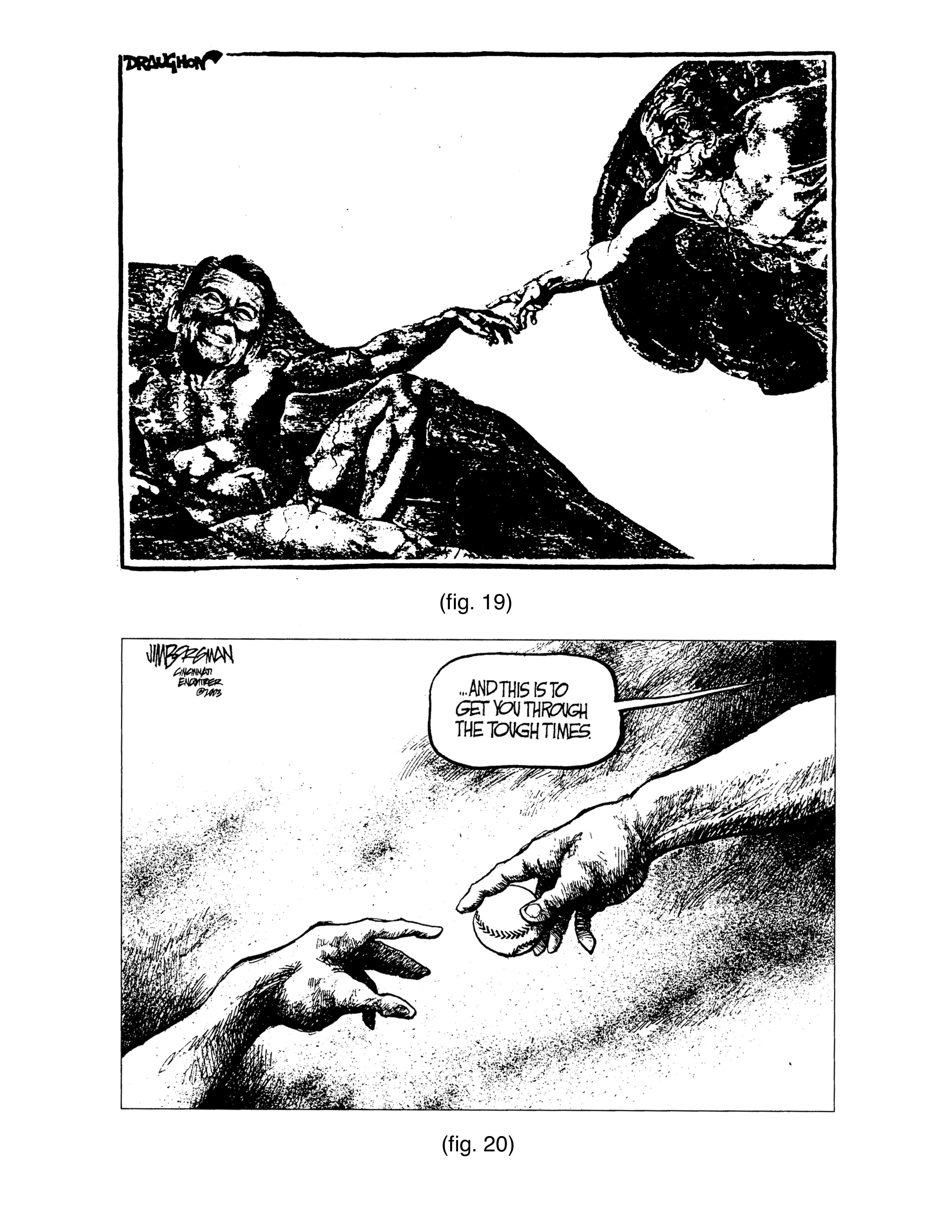
Judging from the alternating use of these two images in editorial cartoons, popular conceptions about the creation and evolution of the human species are still a bone of contention. Perhaps the widespread recurrence of these two competing images in editorial cartoons is simply a reflection of the ordinary human tendency toward self-absorption.
Finally, all eleven cartoonists were asked if they thought the sustained repetition of the “March of Progress” in editorial cartoons and other media helped in any way to spread and reinforce the concept of evolution or if the image had merely become a familiar sight gag that no one gave too much thought. Unfortunately, only a few of the respondents agreed with the author’s assertion that the extensive appearance of the March contributes to the general acceptance of the Darwinian paradigm. Steve Benson agreed that the recurring image of the March “used within the context of a cartoon commentary on science and evolution can serve to convey concepts about the science-based idea of evolution itself.” Rex Babin was even more emphatic in his endorsement when he said that “the use of a familiar image reinforces why that image is familiar in the first place. There is a common understanding of that image because most have come to accept the concept that the image represents.” Conversely, Jape Trostle voiced the majority sentiment that the March was “well on its way to being a familiar sight gag divorced from its original meaning,” even as he conceded the fact that “there are creationists out there who believe that any use of the ‘March of Progress’ in cartoons, ads or satire is simply more evidence of a left-wing conspiracy to spread the lie of evolution.” Matt Wuerker reiterated Trostle’s opinion that “there might be one or two very dim churches way up some valley in the hills of Kentucky where they’d see the image as spreading the word of Satan, but otherwise I think it’s been robbed of it’s shock value.” Chuck Asay doubted that repetition had anything to do with an image’s power to influence, pointing out editorial cartoonists’ penchant for portraying the Statue of Liberty. Asay asked whether “the repetition of her image makes us any more or less free?” In spite of the collective judgment against the March icon’s persuasiveness, the most hopeful assessment of the March icon’s ability to support the Darwinian world view came from Clay Bennett. Hoping that the March was both spreading the concept of evolution and becoming a familiar sight gag, Bennett said “the day that readers view this image as a sight gag involving no thought is the day that the theory of evolution has become so universally accepted that no thought is necessary.”
In conclusion, the use of the March in editorial cartoons will most likely persist in aid of the further dissemination of evolutionary concepts, even though the March is not the best visual representation of human evolution according to Darwin’s theory of descent with modification through natural selection. Rudolph Zallinger’s “March of Progress” is still a potent visual icon and its popularity and persuasiveness is due in part to the unambiguous nature of its rhetorical and demonstrative arguments about progress in human evolution. The ill-informed, yet irresistible sequence of this icon has become the dominant paradigm for the popular understanding of evolutionary science as a whole, and the March has been and will continue to be a profitable metaphor for cartoonists because it provides a means for making fun of ourselves and our pretensions. Zallinger’s enduring image remains indelible because it fulfills a decidedly human need for narrative. It fleshes out our predecessors and its image of progress provides a reassuring link to our distant past. Its ubiquity is therefore understandable. Thanks to the power of the visual medium and the abiding curiosity of people about their origins, the “March of Progress” image and its multitude of comic variations should continue to inform and influence the public view of evolution for some time to come.
(Editor’s note: The essay above was written for a class I took to complete my BA in History from NC State. Footnotes and a bibliography were attached to the original, but are not shared here.)
Remarklable.