Grateful for the First Amendment
Freedom to draw political cartoons is all relative

My last post was a reprint of an undergrad paper I wrote about editorial cartoonists’ use of an icon used to illustrate human evolution. Today’s post is the reprint of another undergrad paper from the same time period (@2007), but written about the perils faced by many editorial cartoonists then working on the African continent.
I am sharing this one last paper because my professor at the time thought it deserved to be published in an academic journal, and because it provides a thoughtful examination of the lack of editorial freedom in a large corner of the world at that time. In contrast, it reminds me how grateful I continue to be for the amount of freedom I have enjoyed throughout the 45 years I have been drawing editorial cartoons.
There have been plenty of cartoons I have drawn during those 45 years that have been killed by an editor or a publisher. I was rarely happy about those decisions by others to censor my work, but I have always had the opportunity to try again with a different idea that day or the next.
In addition, this paper that you are about to read gave me the opportunity to meet and have some wonderful conversations with one of the premier editorial cartoonists still working in Africa today, Johnathan Shapiro, aka Zapiro, currently working for the Daily Maverick in South Africa.
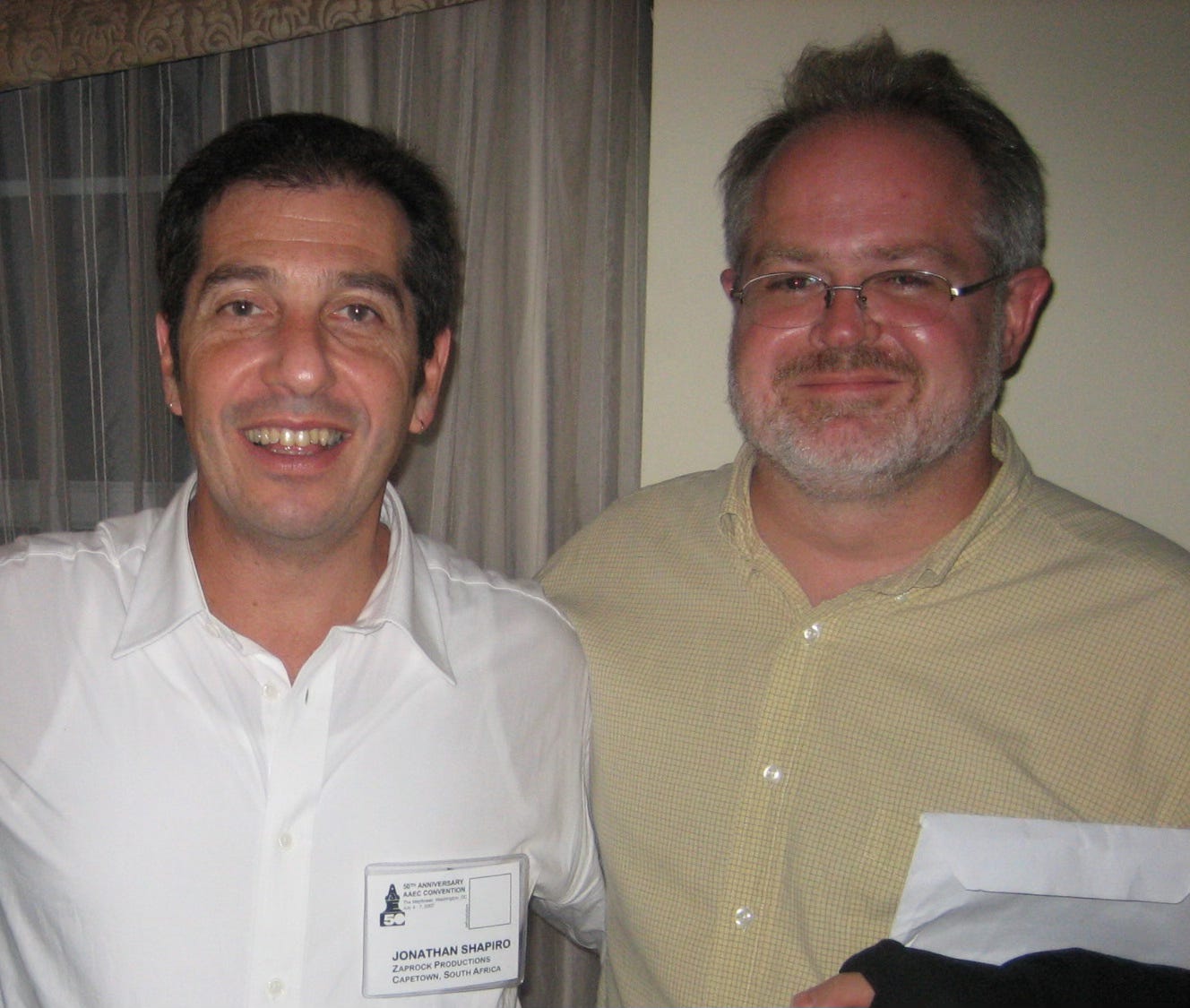
(Zapiro on left, Dennis Draughon on right. Pictures above from 2007 AAEC Convention in Washington, D.C.)
So without further ado, the paper, presented without footnotes or the bibliography as it’s almost 20 years ago since the information was current. I promise that this will be the last long-winded posting of an academic work.
Editorial Cartooning in Africa:
Postcolonial Trappings of the Freedom
of the Press
Dennis Draughon
In early June of 2006, The Cartoonists Rights Network, a nonprofit agency that lobbies on the behalf of persecuted cartoonists around the world, presented its sixth annual Courage in Cartooning Award to Algerian cartoonist Ali Dilam, who accepted the award in person at a dinner in his honor at the Denver Press Club during the Association of American Editorial Cartoonists’ annual convention held in Colorado that year. Dilam was recognized for his perseverance in spite of numerous arrests due to his newspaper cartoons satirizing Algerian government officials. Concurrently, a separate Courage in Cartooning Award was given to the 11 Danish cartoonists who drew cartoons satirizing the Prophet Muhammad for the Danish newspaper, Jyllands-Posten. Those cartoons instigated protests and riots among the Muslim faithful all around the world, led to a number of unfortunate deaths and threats of death, and sparked a global discussion about the relative freedom of the press and, in particular, cartoonists to express controversial ideas in certain areas of the world. Some of the more violent and deadly demonstrations, as well as more measured reactions in the form of censorship and prior restraint took place in Africa, both above and below the Sahara. Both of these awards point to the recent history of challenges and difficulties faced by newspaper political cartoonists quietly practicing their craft on the African continent. Africa’s peculiar history of colonial domination and the evolution of its subsequent movements for independence has determined many of the parameters within which cartoonists, whether black or white, must operate. Many cartoonists in Africa have endured varying degrees of freedom and control, depending on the particular political climate of their respective countries. In Africa today one can find examples that run the entire gamut of experience, from threats, beatings, lawsuits, censorship, imprisonment and even murder to the kind of editorial liberty that is threatened more by self-censorship than by any actions of state government.
Newspapers came relatively late to Africa, with the first recorded European type printing press arriving in Freetown, Sierra Leone in 1794. It did not become fully operational until 1800. For the next hundred and sixty years or so the press in Africa was almost entirely of, by and for Europeans. Labor laws in most of sub-Saharan Africa precluded Africans from working in the media except as service personnel, so native African journalists did not really appear until after independence. A few former British colonies, Nigeria and Ghana, saw the development of an indigenous press as early as the 1860’s, but by and large the newspapers printed in Africa before independence were exclusively for the white colonizers and settlers. The colonial press provided the settler communities with news from the metropole and news of the white colony, but took no account of the news of the local African population, except in cases of violence against whites. After independence, journalism that largely ignored the native population was replaced by various versions of so-called “development journalism” as new nationalist governments sought to unify their political constituencies under one-party rule and push progress through state-owned organs of propaganda. Before the current trend of independent African states establishing multiparty democracies with more liberal press freedoms, newspapers not owned by the state were subject to many forms of censorship and control. In addition to the limitations inherent in the colonial and the immediate postcolonial media models above, the relatively late arrival of journalistic traditions, training and technology has hindered the spread and growth of newspapers throughout the continent. As of 1998, only 11 newspapers were produced for every thousand people living in Africa, compared with an average 96 per thousand for the world as a whole. In 2002 copies of daily newspapers reached 25 out of every 100 individuals in the European Community and North America. In Africa that figure drops to 1.2 out of every 100, 8 points lower than the world aggregate. As a result, Africans are statistically less likely to read newspapers than people anywhere else in the world. Wide scale illiteracy has been one major factor contributing to the slow development of the African press, another has been the thousands of discrete languages and dialects used throughout the continent, many of which have no written form or literature. Since printing newspapers in so many vernacular languages is not a viable proposition, rising literacy rates in some European lingua franca such as English, French or Portuguese is key to the future development of the African press. The lack of adequate infrastructure throughout Africa has limited newspapers’ geographical areas of coverage, restrained their distribution to mostly urban areas and depressed the growth of their circulation. Finally, high production costs and the importation of the bulk of all newsprint used in Africa has negatively affected the domestic newspaper industry due to foreign exchange rates and the often unfavorable terms of trade with the rest of the world.
Although the history of the press in Africa is not a long one, it is interesting to consider the context within which it has developed, that of the legacy of the continent’s oral traditions. This context is of particular interest when considering African political cartoons. Due to low literacy rates, Africa has a high dependence on and respect for oral communications. Radio trottoir, or “pavement radio,” the popular verbal dissemination of underground news and often scabrous rumors concerning those in power, has served an important function as an outlet for the free expression of broad political antipathies during periods when the disenfranchised and dispossessed have had no adequate access to unfettered forms of mass media. Oral communication brooks little censorship and control, and in the case of radio trottoir, the communication is often loaded with the kind of allusive expressions and colorful metaphors that easily elicit strong visual images. Popular African tales of vampires, witches, ghosts, and transmogrification among the ruling elite easily lend themselves to the conventions of political caricature. Thus, radio trottoir can be collectively viewed as a sort of oral political cartoon, enabling the masses to render explicit criticisms of the powers that be. Achille Mbembe, who refers to radio trottoir as the “poor man’s bomb,” reinforces this idea of the relation between collective rumor and cartoons, between “speaking” and “representing.” The image and the word function together for Mbembe since,
“the pictographic sign does not belong solely in the field of ‘seeing’; it also falls in
that of ‘speaking.’ It is in itself a figure of speech, and this speech expresses
itself, not only for itself or as a mode of describing, narrating, and representing
reality, but also as a particular strategy of persuasion, even violence.”
He goes on to suggest that cartoons may even be considered to have magical powers in an African context, just as Africa’s indigenous culture assigned ritual images the power to bridge the gap between the objective, visible world of the living and the subjective, invisible world of spirits. This gives cartoons the same cultural credibility echoed in Stephen Ellis’ assertion that persuasive radio trottoir rumors are created “where the boundaries between what is real and unreal, or true and false, are often unclear.” So it would seem that Africans are predisposed to appreciate the intrinsic power of political cartoons as a means of communication, both by their low level of literacy and strong oral tradition of rumor, ridicule and caricature. Satirical drawings and cartoons offer them an accessible, engaging form of mixing oral culture and popular discourse, while providing a compelling means of expressing popular discontent.
Sensing this power, many shrewd African leaders recognize the political cartoon’s potential for damage to a regime’s legitimacy, although in some instances they were slow to comprehend the nature of the threat. In Cameroon in the early 1990’s, government officials in charge of press censorship did not pay much attention to political caricature, considering its impact negligible at best. At the same time, all other private newspaper content was viewed as potentially subversive and thus subject to prior review and possible censorship by the government. Since cartoon pages were not subject to the same level of scrutiny, enterprising independent editors decided to use more political cartoons in their papers, giving them prominence in placement. It turned out that the government had highly underestimated the influence of cartoons. Since they were funny and easy to understand, even among the illiterate, the cartoon pages attracted more readers in both rural and urban areas and increased the overall circulation of the independent newspapers. The resulting growth was so fast, paid readership quadrupled in the space of one year. Following this huge success, authorities eventually perceived the necessity of controlling the diffusion of political cartoons. At first they tried to counter the threat by printing new papers featuring cartoonists in the government’s employ, but in due course they reverted to more traditional means of control, such as arresting editors and destroying printing presses. The newfound respect Cameroon’s Biya regime accorded political cartoons was evident in its adjustment in media policy. Many leaders in postcolonial Africa have since been able to identify with Boss Tweed, the infamous New York City politician from the late nineteenth century, who was beset with the influence of Thomas Nast’s cartoons illustrating his corruption. An exasperated Boss Tweed is recorded to have demanded of his henchmen, “Stop them damn pictures. I don’t care so much what the papers write about me. My constituents can’t read. But, damn it, they can see pictures.”
Since the introduction of more liberal democratic constitutions and multiparty politics in most African countries during the 1990s, there is more space and tolerance for freedom of expression as most countries in Africa now have opposition and independent newspapers. As a result, cartooning has slowly emerged as a growing profession, though still small in numbers compared with the rest of the developed world. But journalism remains a dangerous profession in Africa, where many journalists are still being harassed, detained, imprisoned and sometimes killed. Cartoonists, while free of the one-party control from the earlier years of independence, face some of these same threats as well as censorship by individuals in the political and financial sectors, with lawsuits becoming more prominent than official government suppression. “From Egypt to South Africa, Nigeria to Kenya, there have always been more or less overt threats to cartoonists, leading to internal censorship in the newspaper houses as a preemptive measure against state harassment,” says Teju Olaniyan, a professor of literature from the University of Wisconsin who is writing a book about African cartoonists. Olaniyan says cartoonists are extremely popular and “many people in Africa trust them to reveal the underside of political actions, policies and events. Cartoonists hold the status of teachers, teaching the people the most important ingredient of civil disobedience: irony.” Unlike ‘ordinary journalism,’ cartoons are neither objective, nor meant to be so, and this gives them their power, says Olaniyan. “Because most mass media outlets in Africa are still government-owned, the African audience already has too much of ‘objectivity,’ which frequently becomes very difficult to distinguish from official propaganda.” Cartoonists provide then a much needed irreverent view to counter Africa’s ‘objective’ reality. Nigerian illustrator Tayo Fatunla says cartoonists “are the envy of most journalists in Africa. In the African press, cartoons come first, before any other content of the paper.” Cartoons and political illustrations are likely to be read before news reports and are thus given special prominence by newspaper owners who realize their importance, especially where literacy rates are low. The African press, according to Fatunla, “sees cartoons as a means of communicating on behalf of the masses to the government,” and because cartoonists know how people feel about government, society and the world, they “become visual commentators on behalf of the masses.” Tanzanian cartoonist Masoud Kipanya agrees that African cartoonists share this self-appointed role,
“The government took us as these people are just playing, you see. But then the
impact started to be seen. Because cartoonists became the voice of the poor
people. We predicted things, spoke to the politicians, we told them things, we
made them understand what is happening, what they were supposed to do as
politicians, as leaders.”
As marginal and innocuous as cartoons may seem to readers of American newspapers, in Africa they are a good barometer of the social and political climate from which they emerge. The state of press freedom in various African countries is closely related to the state of cartooning, although the relation is not without exceptions. Some cartoonists have had to use a variety of inventive strategies to get their messages across in the face of censorship and repression. Others are so popular that their status allows them to work with impunity. Some cartoonists are tolerated much as court jesters of old. Others, not so much. The license enjoyed by cartoonists to caricature and parody public figures is an indicator of a robust democratic culture, but this certainly does not prevail in all countries. A brief survey of Africa reveals an uneven pattern, indicating that the presence of a flourishing cartooning culture is not a guaranteed corollary of democracy and press freedom.
North African countries, especially those wrestling with a growing Muslim fundamentalist movement, have proven to be intimidating environments for some cartoonists even before the violent riots sparked by the Jyllands-Posten cartoons depicting Muhammad. In 1995 the Egyptian parliament adopted a press law that forbade criticism of public officials and made any published contempt for state institutions punishable by jail. The law also made cartoonists liable to prove the accuracy of their offensive parodies in court. In Algeria, Lamari Chawki, cartoonist for the main French language paper, La Tribune, received a suspended three year prison term for mocking the Algerian flag in one of his cartoons. This came after Algerian authorities had arrested Chawki, closed the paper’s editorial offices and suspended the paper for a time in 1996. Sid Ali Malouah, considered Algeria’s foremost cartoonist, received many death threats and was forced to go into hiding after his work incurred the wrath of Muslim fundamentalists, and Guerrovi Brahim, cartoonist for the daily El Moudjahid, was kidnapped and murdered in 1995 as members of the country’s secular intelligentsia continued to be targeted. Ali Dilam, cartoonist since 1993 for the daily newspaper, Liberty, and the 2006 recipient of the Cartoonists Rights Network’s Courage in Cartooning Award, has been attacked by fundamentalist paramilitary forces who issued fatwas for his death and he has been subjected to judicial harassment from the Algerian government. He was awarded for his refusal to choose exile or self-censorship in the face of extreme intimidation. Regarding his legal troubles, Dilam says, “I have accumulated a total term of something like nine years in jail. These days I spend three days a week at the courts.” He maintains there is no freedom of speech in his country, saying that journalists who attack the government pointblank sign their death warrants. Dilam continues to persevere, facing fatwas and jail time, but not without hope. “In Algeria,” he says, “hope is called a visa.”
Cartoonists on the west coast of Africa have seen their share of troubles. In 1999, rebels in Sierra Leone killed Muniru Turay, one of the country’s leading cartoonists. Afterwards they ransacked and burned down the office of his newspaper, destroying his life’s work. In 1984, after making a veiled reference in one of his cartoons to Samuel K. Doe , then Liberia’s head of state, political cartoonist Harrison Jiedueh was threatened by state security forces and advised to flee Liberia for the United States. Two cartoonists in Nigeria, Adenle Adewale and Chukus Onwudinjo, ran afoul of Gen. Sani Abacha’s brutal and corrupt regime and were threatened by the state security forces. Adewale had to go underground and resign his cartooning post at one point. Only after Abacha died in 1998 did the press in Nigeria begin to recover. Nigeria currently has a large number of cartoonists practicing their craft. Nigeria is also the country where protests over the Jyllands-Posten Muhammad cartoons resulted in at least fifteen deaths, the most fatalities in any of the countries involved in violence over the drawings. In February of 2006, Nigerian Muslims attacked and burned Christian churches in the city of Maiduguri and swarmed through the streets with machetes and iron rods, beating people to death, including three children and a priest. Nigeria is roughly divided between a predominantly Muslim north and a mainly Christian south and years of tension and suspicion have led to occasional outbreaks of sectarian violence, most recently exacerbated by the anger over the Danish cartoons.
In Cameroon, President Paul Biya’s regime learned the hard way about the effectiveness of political cartoons, at first ignoring them, then exercising tighter controls as their true power was perceived. It was largely the work of Le Messager cartoonist Paul Nyemb Ntoogue, or “Popoli,” that so vexed President Biya. Popoli was given the Cartoonists Rights Network’s first Courage in Cartooning award in 1999, after he was forced to flee Cameroon because of threats he received regarding his satirical cartoons which depicted President Biya and his wife in a very unfavorable light. While in exile in South Africa he continued to fax his daily cartoon to his newspaper. Despite being offered refugee status in Canada, Popoli later returned to Cameroon. In 2003 he was subjected to vicious beatings at a police checkpoint, prompting the US Embassy to lodge an official protest and demand an investigation. Popoli has since toned down his work, much to the chagrin of his many fans, who have told the artist that his cartoons no longer reflect the truth as they once did.
Eastern Africa provides cartoonists with a somewhat less hostile atmosphere than that of the Mediterranean and Atlantic coasts. Kenya is perhaps the most healthy landscape for cartoonists in this part of Africa, as evidenced by the career of Godfrey Mwampembwa, aka “Gado.” Gado has been cartooning since 1985, moving to Kenya in 1992 to become editorial cartoonist for the Nairobi based Nation Media Group and The Daily Nation, the largest newspaper operation in eastern and central Africa. Gado’s work is syndicated around the world, and perhaps because of his fame he has no qualms about depicting former President Daniel Arap Moi as an absolute dictator. Gado came to Kenya as the one party system was opening up, so he was less affected by the caution exercised by previous cartoonists and editors when negative portrayals of Moi were forbidden. “Certainly I received occasional letters and was threatened, but I was never physically assaulted,” says Gado. “Things are definitely improving for cartoonists in Kenya. Over the years the political class have learned to take criticism and complaints against cartoonists have gone down. And our work is increasingly appreciated, especially by young people.” But even Gado finds himself under the gun with the new weapon of choice used to intimidate the press-- litigation. In July of 2006 Kenya’s Minister of Justice and Constitutional Affairs Martha Karua threatened to sue Gado for the implications of an unkind caricature.
Neighboring Tanzania has a surprisingly robust cartooning community. As late as 1988 there were only two daily newspapers, one owned by the government and the other owned by the ruling party. Now, many years after the country’s first multiparty elections in 1995, there are many daily independent papers and over 30 weekly papers in the capital, Dar es Salaam. The capital city supports over twenty cartoonists, most of them working for newspapers printed in Swahili. One theory put forth to explain Tanzania’s surfeit of local cartoonists was the relative weakness of the Tanzanian currency in dollar terms, which made hiring local talent cheaper than buying syndicated cartoons produced outside the country. Curiously, in other African countries, the use of cheaper internationally syndicated material was most often cited as a major deterrent to the development of indigenous cartooning talent. Malawi, the country next door, apparently enjoyed a brief flowering of political cartoon art in the mid-1990’s after the downfall of former President for Life Hastings Banda. Following the inauguration of a multiparty system there was a rapid proliferation of independent newspapers and some twenty Malawian cartoonists emerged within previously unknown levels of freedom of expression. Many of their cartoons appeared on the front pages of their respective newspapers. Now those independent papers no longer exist and the cartoonists who once worked for them have since returned to obscurity.
Unlike Tanzania and Nigeria, Zambia is practically devoid of political cartooning, with the exception of The Post’s “Yuss.” Trevor Ford, the Welshman who has worked in Zambia for over thirty years, is the popular cartoonist’s real name. Zambia is a highly literate country, but despite favorable conditions cartooning has never been a significant part of the media. Although interest in cartooning is high, the development of the craft amongst native Zambians has stalled due to the lack of training, scarcity of privately owned media, fear of government retaliation, and unobliging editors saddled with budgetary restraints.
In contrast, neighboring Zimbabwe is not exactly a hotbed of cartooning culture either, but it does boast the travails of a particularly headstrong cartoonist. Tony Namate, former cartoonist for the Daily News in Harare, has been a constant thorn in the side of Zimbabwe’s President Robert Mugabe. Namate was the 2004 recipient of the Cartoonists Rights Network’s Courage in Cartooning Award for his refusal to back down amidst the constant threats of economic depravation, physical harm and arrest. A number of daily and weekly newspapers that Namate has worked for over the years have all been closed down by the government at one time or another, and the Daily News offices were even bombed twice. Ordered by the Ministry of Communication to register as a journalist, Namate refused, citing the freedom of the press and likening the required registration to the Nazi requirement that all Jews wear a Star of David arm band. Namate has been singled out in hate speeches by enraged government officials. A 1997 cartoon of Namate’s incited government minister Joyce Mujuru to say that the cartoon was “treasonable, infuriating, unacceptable and coming from an untamable and uncultured animal.” She also threatened to sue Namate for damages on behalf of the state. A televised 2001 speech by a former Minister of Defense, Moven Mahachi, accused Namate of being unpatriotic. Namate has also been accused of being a paid agent of the embittered, white, former “Rhodesians” because his cartoons appeared in an opposition newspaper owned by same. In 2005 Namate’s name was reputed to be on a government hit list of its internal enemies. Citizens on the list would have their passports withdrawn if they tried to leave the country. Undeterred, the beleaguered Namate says, “I no longer see myself as a cartoonist but as a human rights campaigner.” Namate’s Zambian colleague, Innocent Mpofu, who cartoons for the state-controlled Herald in Harare, restricts himself to commenting on broad social themes as he is not allowed to employ caricature in his cartoons for his newspaper, the official mouthpiece of the Mugabe regime.
Finally, in South Africa there resides a prolific cartoonist who some would consider the dean of the profession on the continent, by virtue of his impressive longevity throughout South Africa’s extraordinary political transformation and by his national audience and the worldwide syndication of his cartoons. Jonathan Shapiro, aka “Zapiro,” is the cartoonist for the Sowetan, Sunday Times and the Mail and Guardian, and he is held in high regard for his past dedication to the denunciation and eventual elimination of apartheid. Zapiro was fully committed to the struggle for national liberation and he displayed a level of activism few other white writers and artists of that time could match. In 1988, while getting his start in the ranks of the alternative opposition press, Zapiro had to go into hiding after being threatened by the Botha regime. He was eventually detained and put in solitary confinement by the security police for five days that same year. As the struggle progressed, Zapiro’s cartoons increased in popularity until he was wielding a considerable amount of influence. His cartoons played an important role in reinforcing the antiapartheid cause. In April of 2006 he was the first cartoonist to be named South African Journalist of the Year, besting more than 180 other journalists in consideration. The only other South African cartoonist to gain such acclaim was Rico Schacherl, who, in collaboration with Stephen Francis and Harry Dugmore, produced the groundbreaking comic strip “Madam and Eve.” The successful strip featured the relationship between a white South African madam and her domestic servant and it examined the evolving nature of the country’s black and white relations during the waning years of apartheid and beyond. “Madam and Eve,” as a comic strip, was once listed among the top one hundred most influential people in South Africa. Zapiro’s political cartoons and “Madam and Eve” happened along at just the right time to capture the new national zeitgeist, in the process becoming icons of freedom in the new South Africa.
Today Zapiro enjoys a level of editorial freedom that is the envy of cartoonists elsewhere on the continent. Instead of fearing imprisonment, Zapiro, whose allegiance still lies with the ANC, now agonizes over criticizing leaders he admires. It took the cartoonist some time to readjust and reconcile his former role as a party activist with the more traditional role of the political cartoonist as independent watchdog and critic of government intemperance. Even as South Africa’s new political system has ushered in an unprecedented era of press freedom, there are still significant perils for the practicing cartoonist. Litigation remains an effective impediment to the free exchange of ideas, and it is a trend that, if left unchecked, could put Africa’s nascent freedom of expression on ice. Like Gado in Kenya, Zapiro faces a lawsuit from an ex-government official, in this case Jacob Zuma, a former deputy president of South Africa. In 2006 he filed a lawsuit against Zapiro, claiming he had been “crucified” by a series of cartoons making fun of, among other stands, Zuma’s rather odd beliefs about AIDS. Zuma is seeking over a million dollars in damages from Zapiro and multiples of this amount from the various newspapers that published the drawings. A concurrent legal development in South Africa, with the potential to set a chilling precedent for cartoonists, is a ruling by the Johannesburg High Court regarding the Jyllands-Posten Muhammad cartoons. In early 2006 the Muslim Judicial Council applied to the High Court for a judgment to prevent South Africa’s largest newspapers from reprinting the cartoons which many of the world’s Muslims considered offensive. The High Court agreed with the Muslim Council’s argument that the cartoons impinged on the Muslim community’s constitutional right to dignity. The South African Freedom of Expression Institute countered that the ruling threatens the country’s freedom of the press, while the Independent Media Group, one of the publishers involved in the case, apologized for its initial error in judgment.
As countries in Africa continue to expand their more recent experiments with multiparty democracies, cartoonists should continue to find hope in their evolving work environments. While journalism is still a daunting profession on much of the continent due to harassment, intimidation, imprisonment and death threats, there are some bright spots in the recent media policies and practices of eastern and southern Africa, most notably in Kenya and South Africa. Certainly there is a growing demand for independent voices and views where the state controlled media once peddled “one size fits all” news and commentary. The media in Africa are unique. No other place on earth has had to endure such rapid change in communication, from oral tradition to electronic discourse, with scarcely a pause in between. Major changes are in the offing as new freedoms, new technologies, new training and new competitive media outlets offer the African people a new course for the future. Transformation seems inevitable with the advent of democratization processes, the growth of civic organizations and civil society, global innovations in communications technology and the advocacy of international groups promoting freedom of the press. Although the first newspaper appeared on the continent in the early 1800’s, the birth of the modern African press began only after the dawn of the independence movement fifty years ago. Analogies to the development of the press in the West would suggest that Africa’s early attempts to learn to walk will be followed by many falls and a subsequent period of struggle, just as surely as that initial struggle will eventually be followed by a confident stride. Cartoonists are no doubt hoping that, much like Cecil Rhodes’ fevered dreams of empire, the spirit of free expression and freedom of the press will progress and continue to march forward from Cape to Cairo.